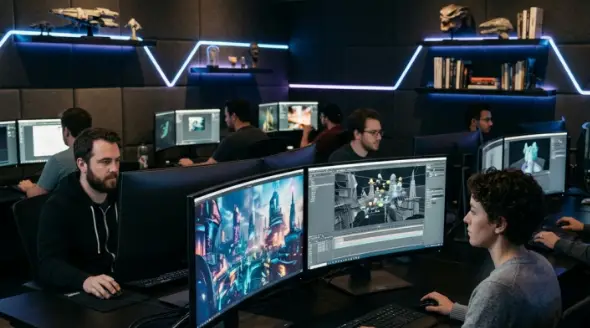
The entertainment industry is currently undergoing a structural evolution driven by deep learning and visual computing. For decades, the visual effects (VFX) required for blockbuster movies, television shows, and high-end video games have been defined by exorbitant budgets and punishing production schedules. Creating a convincing digital world meant hiring hundreds of computer graphics artists to manually build, texture, and light every single background asset. A digital medieval city or a futuristic sci-fi corridor required millions of dollars in human labor alone. Today, this grueling manual pipeline is being rapidly replaced. Advanced spatial technologies from platforms like Neural4D are allowing studios to bypass the most tedious aspects of 3D modeling by instantly generating photorealistic digital assets from simple 2D reference images or video footage.
This profound disruption in digital entertainment production is the direct result of intense academic and commercial research. Neural4D emerged from rigorous collaborative studies conducted by engineering teams at Nanjing University, DreamTech, Oxford University, and Fudan University. By utilizing proprietary Spatial Sparse Attention (SSA) technology alongside the Direct3D-S2 framework, the platform delivers highly efficient automated 3D asset generation for VFX that integrates directly into established Hollywood pipelines. The ability to automatically produce millimeter-accurate digital twins allows production studios to drastically reduce rendering timelines while simultaneously improving the visual fidelity of their final cuts.
The Production Bottlenecks in Modern Visual Effects
To truly understand the value of generative AI in entertainment, one must examine the traditional friction points of VFX production. In a standard feature film, the background environment is often completely synthetic. This means that every rock, building, vehicle, and piece of furniture in the background must be digitally constructed.
Historically, this required a highly skilled 3D modeler to sit in front of Maya or ZBrush and sculpt the object from scratch. After the geometry was finalized, another artist had to unwrap the digital model and manually paint the textures to ensure it reacted properly to virtual lighting. If a director changed their mind about the aesthetic of a scene during post-production, hundreds of hours of manual labor were instantly wasted.
Generative AI fundamentally solves this massive scaling problem.
- Instant Prop Generation: A production designer can take a photograph of an antique chair they found at a flea market, upload the photo to a generative AI platform, and receive a fully textured, watertight 3D mesh in minutes. This digital prop can then be duplicated thousands of times to fill a virtual auditorium.
- Iterative Set Design: Directors can now experiment with visual styles in real-time. Instead of waiting weeks for an art department to build a digital set, they can generate multiple variations of a scene almost instantly, allowing for rapid creative decision-making.
- Digital Double Creation: For action sequences, studios frequently use digital doubles of actors to perform dangerous stunts. By using AI to process basic video footage of the actor, studios can generate highly accurate 3D body scans without needing million-dollar photogrammetry rigs.
Democratizing Independent Filmmaking
While massive Hollywood studios are adopting these tools to save millions of dollars, the most exciting impact of this technology is occurring at the independent level. Historically, independent filmmakers could not afford extensive visual effects. Their scripts were strictly limited by their physical budgets; if they could not afford to build a practical set, they could not shoot the scene.
The democratization of 3D asset generation has completely erased that boundary. An independent director working on a micro-budget can now utilize virtual production techniques. By projecting generated 3D environments onto LED volumes, small crews can shoot scenes that look like they were filmed in massive fantasy worlds or deep space.
This shift has also sparked a massive culture of collaborative asset sharing among digital creators. Independent filmmakers and digital artists frequently create unique 3D props and share them with the broader community. For a director needing specific background elements, resources like the DIY3D model sharing platform have become invaluable. Creators upload thousands of structurally verified, pre-textured models that are ready to be dropped into popular game engines like Unreal Engine, which is increasingly being used for real-time filmmaking. By utilizing these shared digital repositories, independent filmmakers can build complex cinematic environments without spending a dime on manual asset creation.
Technical Considerations for Studio Integration
For VFX supervisors and post-production houses looking to integrate these generative pipelines into their daily operations, several technical factors must be addressed to ensure success.
Topology and Mesh Optimization: A generated 3D model might look visually perfect on a flat screen, but it must perform efficiently within a massive rendering software like Houdini or Nuke. Generative platforms must provide intelligent polygon decimation. If a background prop contains too many polygons, it will cause severe bottlenecks during the final rendering process. Ensuring that the generated assets are properly retopologized is critical for maintaining studio timelines.
Standardized Export Formats: The AI platform must export files in industry-standard formats such as USD (Universal Scene Description), OBJ, or FBX. This ensures that the generated assets can be seamlessly passed between different departments, from the modeling team to the texture artists and finally to the lighting department, without requiring complex file conversions that might corrupt the data.
Consistency in Art Direction: Maintaining a cohesive visual style across thousands of generated assets requires strict oversight. Art directors must carefully manage the reference images fed into the AI to ensure that the lighting, texture resolution, and overall aesthetic match the specific visual tone of the film or game.
“The integration of deep learning into visual effects does not replace the artist; it eliminates the mundane labor. When an artist is freed from manually building background geometry, they can dedicate their entire focus to the emotional resonance and creative lighting of the scene.”
The transition from manual digital sculpting to AI-assisted generation is reshaping how modern entertainment is produced. The automation of this highly technical process through advanced neural networks is removing the final financial barriers to entry for ambitious storytellers. By embracing these powerful visualization tools, both major studios and independent creators are fundamentally expanding the scale of the worlds they can bring to the screen. The next era of blockbuster entertainment will be defined by the seamless integration of human creativity and generative artificial intelligence.
Also Read: Best File Preparation Tools of 2026: Top Tools for Splitting PDFs for Distribution or Upload Limits